





June 10, 2026
About the Author: Children's Music Academy

Screens are now part of childhood. Used wisely, technology can certainly be helpful. Yet when screen time becomes too dominant, children may miss out on slower, richer and more human experiences that help them develop deeply.
This is why the conversation around screen time vs music time: how live music-making benefits children is so important for today’s families.
Live music-making offers something screens cannot fully replace.

Screens give instant results, music builds lasting skills
A screen often offers immediate stimulation.
A child presses, swipes or watches, and something happens instantly.
This can be exciting, but it can also train the mind to expect constant novelty and quick rewards.
Music works differently.
It teaches children that progress grows through attention, patience and repetition.
A short melody may take several attempts.
A rhythm may need to be clapped slowly before it feels natural.
A new song may sound uncertain at first before it becomes confident.
This process is extremely valuable.
Children learn that mistakes are not failures, but part of learning.
They discover that effort leads to improvement.
They begin to understand that something beautiful can be built gradually.
In a world of instant responses, music gives children the gift of patience.

Live music strengthens concentration
Many parents worry that their child struggles to focus.
This is understandable.
Modern life is full of distractions, and children are often surrounded by fast-moving images, alerts and rapid changes of attention.
Music-making gently trains concentration in a natural way.
A child must listen to the teacher, follow the rhythm, notice pitch, remember patterns and coordinate their body.
They may need to watch their hands, read simple notation, count beats or wait for their turn to play.
This kind of focus is not forced.
It grows through involvement.
Because music is enjoyable, children often concentrate without feeling that they are being asked to “sit still and pay attention” in a strict way.
Over time, this can support a child’s ability to listen carefully, complete tasks and remain present.

Music develops coordination and body awareness
Screen time usually involves limited physical movement.
Even when a child is mentally engaged, the body is often still.
Music is different because it brings the body into learning.
A young pianist learns to move fingers independently.
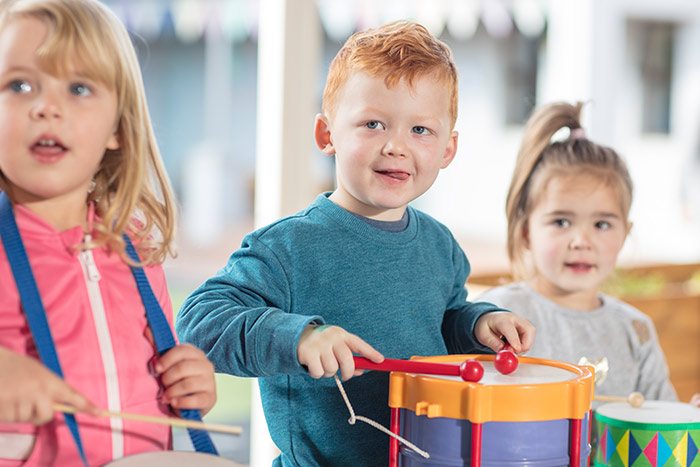
A drummer develops timing and control.
A singer becomes aware of breathing and posture.
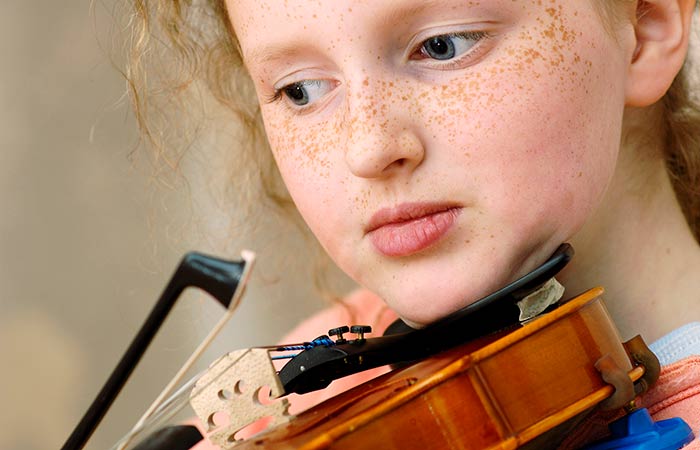
A violinist learns balance, bow direction and careful hand placement.
These actions may look simple from the outside, but they involve remarkable coordination.
The brain, ear, eyes and body must work together.
For children, this is especially powerful.
Music can help develop fine motor skills, rhythm, balance and physical confidence.
It teaches the child to feel organised in their own body, which can be beneficial far beyond the music lesson itself.

Music teaches listening in a deeper way
Children hear sound all day, but hearing is not the same as listening.
Live music-making teaches children to listen with intention.
They learn to notice whether a note is high or low, soft or loud, smooth or detached.
They begin to hear whether they are playing in time, whether a phrase needs more shape, or whether their sound could be gentler.
This kind of listening encourages sensitivity.
It helps children become more aware of detail, mood and expression.
They are not only learning to play an instrument; they are learning to pay attention to the world more carefully.
For many children, this is one of the most beautiful benefits of music education.
They begin to hear more.

Music encourages emotional expression
Children do not always have the words to describe what they feel.
Music can give them another language.
A song can be joyful, calm, lively, mysterious, playful or thoughtful.
Through music, children can explore emotion safely and creatively.
They can express energy through rhythm, tenderness through melody, and confidence through performance.
This is very different from simply consuming entertainment.
When a child makes music, they take part in the emotional world of the piece.
They shape it. They respond to it.
They begin to understand that sound can carry feelings.
This can be especially helpful for children who are shy, sensitive or still developing confidence.
Music allows them to express themselves without needing to explain everything in words.

Music builds confidence, connection and creativity
Live music-making helps children grow in ways that go far beyond the instrument.
When a child learns a new piece, remembers a rhythm or plays something that once felt difficult, they experience genuine progress.
These small victories build confidence, motivation and resilience.
Music also creates connection.
In lessons, children listen, respond, imitate, ask questions and share sound with another person.
Whether they are singing with a teacher, playing a duet or performing for family, music becomes a form of communication.
At the same time, music encourages creativity.
Rather than simply watching a finished world on a screen, children make choices about sound, rhythm, mood and expression.
They learn that their ideas matter, and that they can create something meaningful of their own.

Music can become a healthy routine
Parents often ask how to reduce screen time without turning it into a battle.
One of the best approaches is not simply to remove screens, but to offer meaningful alternatives.
Music can become one of those alternatives.
A short daily practice session, a weekly lesson, singing together at home or playing a familiar piece after school can all create a healthy rhythm in a child’s week.
Music time does not need to be long to be valuable.
Even ten focused minutes can help a child reconnect with sound, movement and concentration.
The key is consistency.
When music becomes part of normal life, it offers children a positive habit that can continue for years.

It is not about rejecting technology
The aim is not to say that screens are bad and music is good.
Technology has its place, and many children use digital tools for learning, communication and inspiration.
The real question is balance.
Children need experiences that involve the whole person: body, mind, emotion, imagination and human connection.
Live music-making offers exactly that.
It slows things down.
It deepens attention.
It encourages expression.
It helps children experience the satisfaction of creating something real.
In a fast digital world, music gives children a different kind of richness.

Choosing music time for your child
If your child enjoys music, sings around the house, taps rhythms, dances to songs or shows curiosity about instruments, it may be the right time to begin.
They do not need to be naturally gifted.
They do not need to be unusually disciplined.
They simply need the right encouragement, a supportive teacher and an environment where learning feels positive.
At Child Music Academy, music lessons are designed to help children grow with confidence, care and joy.
Through live music-making, children can develop skills that go far beyond the instrument: listening, patience, coordination, creativity, emotional expression and self-belief.
Screens may entertain children for a moment.
Music can shape them for life.
RELATED POSTS